
How to Make Easy Kimchi
In this post, I want to show you how to make an easy version of kimchi without overcomplicating things. By using easy-to-find ingredients, you can bring the most famous and international Korean dish into your own kitchen.
Kimchi has a bold, spicy, and deeply savory flavor. While it is enjoyed in practically every major city in the world, nothing compares to the nutritional profile of a “live,” unpasteurized batch made in your own home. It is usually served as a banchan (side dish), but as you will see, its uses in a healthy diet are endless.
Kimchi is more than just fermented cabbage, it is a complex, spicy, and deeply flavorful living food that transforms your metabolic health.
What is Kimchi? The Science of Lactic Fermentation
At its core, making kimchi involves marinating cabbage and other vegetables in a potent paste containing garlic, ginger, cayenne pepper, spring onion, and rice grits.
When vegetables are preserved in a salty medium, they undergo a process called lactic fermentation. This occurs in the cytoplasm of the cells and consists of the degradation of glucose to obtain metabolic energy and the production of lactic acid.
Breaking Down the Sugars
To make it easier to understand: fermentation breaks down the carbohydrates (monosaccharides, disaccharides, and starches) into lactic acid. It essentially “pre-digests” the sugars, glucose, fructose, and galactose, turning them into beneficial acid.
This lactic acid is what preserves the food. By lowering the pH of the medium and acidifying it, it stops the decomposition process and prevents harmful microorganisms from appearing. This entire process must occur in an anaerobic environment (without oxygen), which is why the cabbage must remain submerged or tightly packed in its maceration liquid.
When kimchi ferments, its organoleptic characteristics change, and its flavor evolves into something much richer and more complex.
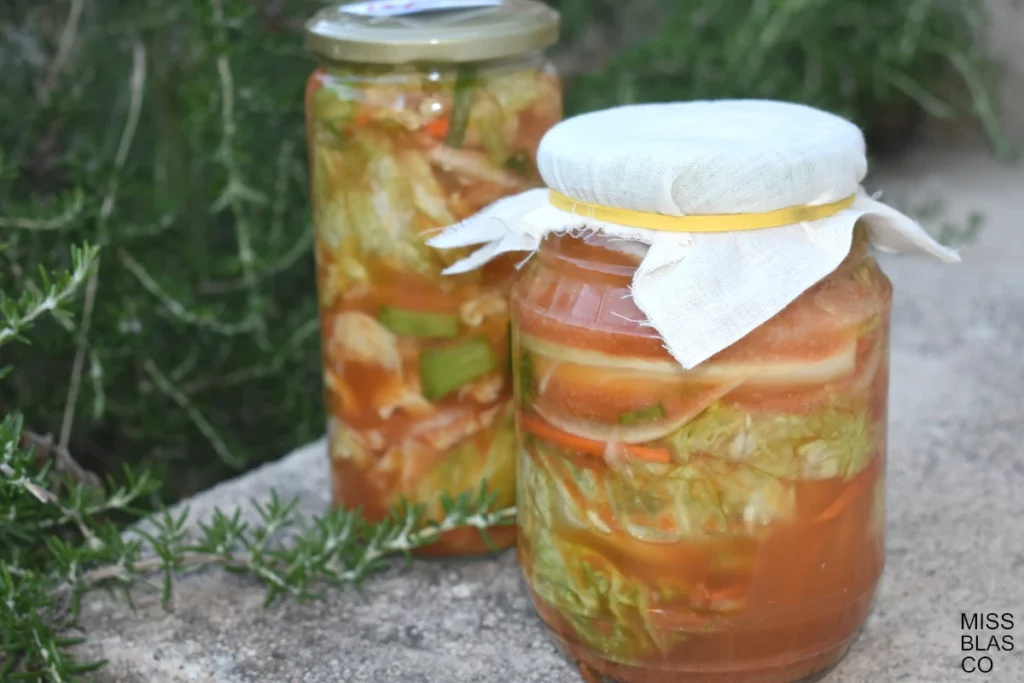
The Hero Ingredient: Lactobacillus kimchii
Almost 20 years ago, scientists isolated a specific bacterium responsible for giving kimchi its unique characteristics: Lactobacillus kimchii. Together with other species like Streptococcus and Weissella, these bacteria are the “engine” behind the flavor and health benefits of this dish.
Regional Variations
Because kimchi is a national treasure in Korea, there are hundreds of regional recipes.
In the North: Kimchi tends to be “watery,” with less salt and less heat, and usually excludes seafood.
In the South: The sauce is thicker and spicier, often including brined seafood or fermented anchovy juice.
My proposal is an Easy Kimchi, a middle ground that uses ingredients you likely already have at your fingertips.
Step-by-Step: The Easy Kimchi Method
- The cabbage is left for a few hours in brine to soften and release its water. This is a crucial step for texture. Nutritionist’s Tip: Make sure to rinse the cabbage well after this step to control the final salt content.
- Mix your garlic, ginger, cayenne, and spring onions. Don’t be scared if the paste seems too strong or spicy at first, The fermentation process will mellow the heat and add new, delicious nuances. You can also use a comercial kimchi paste.
- Once mixed, store the kimchi at room temperature for about 48 hours. The ideal temperature is between 64°F and 68°F (18-24ºC). If your kitchen is warmer (around 68ºF), 24 hours might be enough.
- After two days, press the cabbage down. If you see little bubbles rising to the surface, congratulations! The process has started successfully.
- Now, move it to the refrigerator. It will continue to ferment slowly, developing flavor for weeks or even months.
Kimchi is the most famous dish in Korea with infinite variations; I propose this easy version so you can start your fermentation journey today.
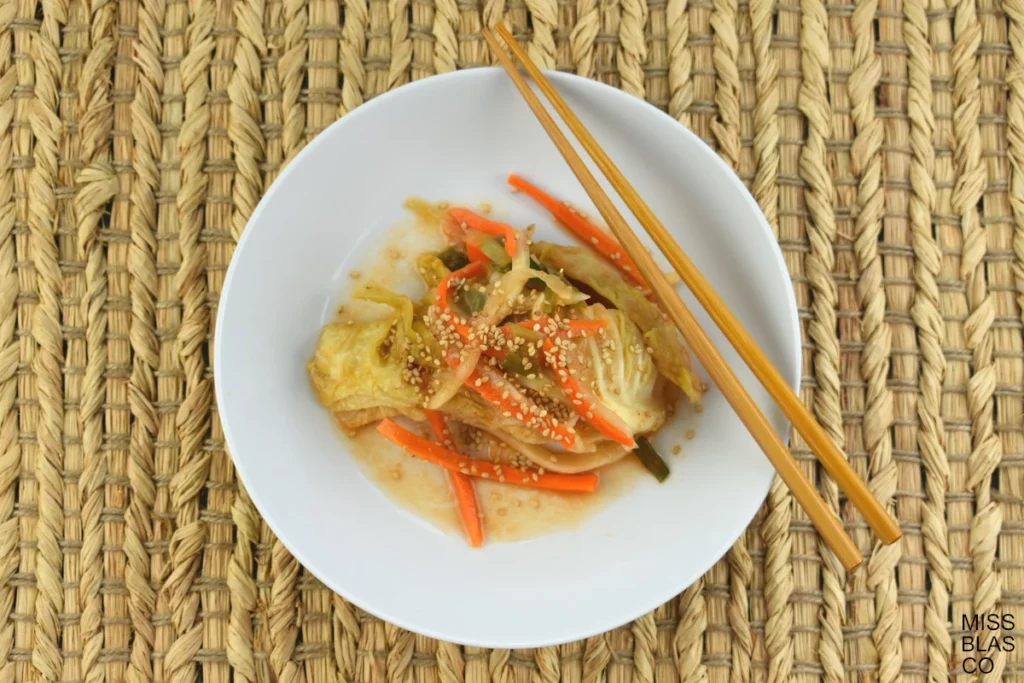
Why I Love This Recipe (And Why Your Gut Will Too)
As a clinical nutritionist, I recommend kimchi for more than just its taste. It is a “live” food that provides a wide variety of microorganisms to improve your intestinal microbiota.
Key Health Benefits:
- Anti-Inflammatory: It is considered a suitable food for treating inflammatory diseases.
- Fungal Support: Studies have shown that the Lactobacillus in kimchi can help combat infections like Candida.
- Nutrient Dense: It is a source of Vitamins C, A, B1, and B2, as well as carotenes.
- Low Calorie: High in water and fiber, it is very satiating while being low in energy density.
Kimchi provides live microorganisms that act as natural probiotics, diversifying and strengthening your intestinal microbiota.
How to Enjoy Your Homemade Kimchi
One of the best parts of having a jar of kimchi in the fridge is the convenience. It keeps for months and only gets better with time.
- Serve a small portion as a side to any meal.
- Pair it with quinoa or brown rice.
- Add it to a hot tofu soup or sauté it with marinated tofu.
- It provides the perfect acidic “kick” to any noodle soup.
Spending a quiet weekend preparing a batch of kimchi is an investment in your health. Watching the nuances of flavor change as the days go by is one of the great joys of fermentation. It gives you freedom, allows you to control the ingredients, and adds a vibrant texture to your daily dishes.
Are you ready to try making your own easy kimchi? Let me know in the comments how your first batch turns out.
Explore my full collection of probiotic recipes:
- How to make sauerkraut at home
- How to ferment vegetables at home
- How to ferment lemons
- How to ferment cucumbers
Check more info about gut health:
How to Make Easy Kimchi
Equipment
- Glass jars
- Wooden spoon
- Big bowl
Ingredients
For the Vegetable Base:
- 2 lb Napa Cabbage Akusay: 1 medium head. (If unavailable, use green cabbage).
- 1 cup Coarse Sea Salt For brining (you may not need it all).
- 1 lb White Radish Daikon: 1 large unit, julienned.
- 1/2 lb Carrot 2 large unit, julienned or grated.
- 1/4 lb Green Onions The green stalks/tops only.
For the Kimchi Paste:
- ½ tbsp Ground Cayenne Or 4–6 dried chili peppers.
- ½ tbsp Smoked Paprika Optional "Spanish touch."
- 4 tbsp Soy Sauce (A vegan alternative to the traditional fish sauce).
- ½ cup Cooked White Rice Soft-cooked.
- 3 cups Rice Cooking Water Use the salted water from boiling the rice, this acts as the starch base.
- 1/8 lb Garlic 3-4 cloves.
- 1/8 lb Spring Onion 1 whole unit.
- 1 tbsp Fresh Ginger Peeled.
Instructions
- Wash the cabbage and cut it into quarters lengthwise. If it is very large, cut each quarter in half again. Spread the coarse salt thoroughly over the cabbage, making sure to rub it on the outside and between each individual leaf.
- Rest: Let the cabbage macerate at room temperature for 5–6 hours. The cabbage will release its water and soften.
- Rinse: After the resting period, rinse the cabbage thoroughly under cold water to remove the excess salt.
- While the cabbage rests, julienne or grate the radish and carrots as finely as possible. Chop the green onions. Boil the white rice in salted water for about 20 minutes until very soft. Reserve both the rice and the starchy cooking water.
- In a food processor or blender, combine the garlic, fresh ginger, spring onion, cayenne, paprika (optional), soy sauce, cooked rice, and the reserved rice water. Blend until you achieve a smooth paste. (Or use a comercial kimchi paste).
- Mix the julienned vegetables (radish, carrot, green onion) with the spicy paste. Using your hands (gloves are recommended), rub this mixture onto the cabbage quarters, ensuring the paste is well-distributed between every leaf.
- Note: The cabbage should eventually be submerged in liquid. If the paste isn't enough to cover it, you may need to blend a bit more liquid base.
- Pack the cabbage tightly into glass jars or a flat glass container. Press down firmly to remove air pockets, (use a wooden spoon, not a metalic one).
- Wait: Leave it at room temperature for 48 hours. (Summer Tip: If it is very hot (over 24°C/75°F), 24 hours may be enough.)
- The Bubble Test: Press the cabbage down with a spoon, if small bubbles rise to the surface, the fermentation has successfully begun.
- After the initial room-temperature ferment, store the kimchi in the refrigerator. Ensure the cabbage remains submerged in the liquid.
- The Trick: Place a reserved clean cabbage leaf on the top layer and use a heavy piece of radish or carrot to act as a weight, pressing the kimchi down into the brine.
- Be patient; while it's ready to eat now, the flavors will only get better over the next few weeks and months.
BASICS, FERMENTATION, GUT HEALTH, HEALTH, KIMCHI, LOW CARB, PROBIOTICS
Natalia
Al ser un alimento fermentado y cambiar su composición, pierde parte de sus propiedades internas y descomponer la fructosa , galactosa y glucosa, mi pregunta es, ¿las personas con malabsorción de la fructosa e intolerancia a la lactosa, podrían tomarla como un buen alimento?
missblasco
Cuando hay intolerancia a la lactosa y además malabsorción de fructosa, los protocolos dietéticos a seguir son complejos, dependiendo del grado de afectación, se puede pautar una dieta baja en FODMAP por parte de un especialista que controlará las diferentes fases del proceso. Los vegetales al fermentar cambian sus propiedades, pero eso no significa que sean aptos necesariamente en todos los casos, así que no puedo afirmar que el kimchi sea adecuado para ti. Saludos!
Patricia Perez
Tiene muy buena pinta, pero tiene mucha cantidad de sal según veo en la tabla nutricional que añades. Esto seria un aspecto bastante negativo de este alimento.
missblasco
Hola Patricia, la sal tiene una función, se utiliza para frotar la col con ella y dejarla “sudar”, cuando ya ha perdido agua, se enjuaga para eliminar ese exceso de sal (paso 3 de la receta).
Saludos cordiales.