How to Ferment Cucumbers
Fermenting cucumbers is incredibly easy. Like almost any vegetable, the process is simply about preparing a brine and keeping the vegetables submerged in it for a few days. If you’ve been intimidated by fermentation in the past, cucumbers are the perfect place to start. They are among the fastest-fermenting vegetables, especially in the summer, and the reward is a crunchy, tangy, and living food that transforms your digestive health.
In this guide, I will share my clinical nutritionist’s perspective on why these “live” pickles are a must-have in your refrigerator and how you can master the technique with just a few basic tools.
Fermenting cucumbers and other vegetables at home is not only a culinary skill but a very easy and affordable way to invest in your long-term health.
Why Fermented Cucumbers? (Beyond the Crunch)
As a nutritionist with over 10 years of experience, I always emphasize that any fermented food, even those with short fermentation periods, provides live microorganisms to our microbiota. These beneficial bacteria help “seed” your gut, improving digestion and boosting your immune system.
Unlike industrial pickles, which are usually preserved in vinegar and then pasteurized (killing all beneficial bacteria), wild-fermented cucumbers are alive. They offer a complex, vinegary, and acidic flavor that comes naturally from lactic acid fermentation.
Versatility in the Kitchen
I love using fermented cucumbers in salads or mixed with sprouted legumes, for example, sprouted red lentils with fermented onion and carrot on a bed of green leaves, finished with a fermented lemon vinaigrette. They are also the perfect side dish. Imagine a traditional Bratwurst with sauerkraut and fermented cucumbers, topped with mustard sauce and fresh arugula.
Whether you are a vegetarian or a meat-lover, these pickles add the “umami” and acidity every dish needs.
Understanding the Process: Temperature and Time
Temperature and time are your two fundamental factors.
- The Heat Factor: In summer, if the room temperature exceeds 73–74ºF (23-24ºC), your cucumbers might be ready in just 5 to 10 days. If it’s even hotter, check them at day 5.
- The Cold Factor: In winter, at temperatures around 18ºC or lower, the fermentation slows down significantly, and you will need more time to reach the desired acidity.
What to Expect:
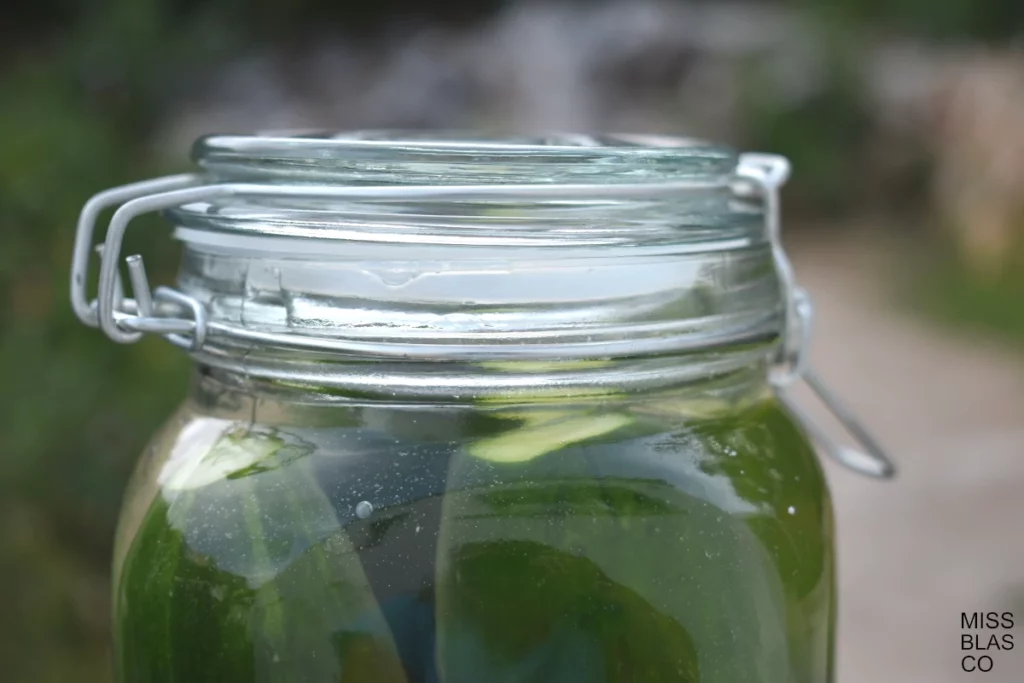
Day 1: The brine will be clear.
Morning After (8–12 hours): You will see bubbles rising from the bottom to the surface, a very good sign that the process has begun.
Day 2 and beyond: The water will become cloudy and turn a milky white. Don’t worry! This is exactly what we want, it indicates that the healthy bacteria and yeasts are growing and thriving.
To make these fermented cucumbers, there is one fundamental and irreplaceable ingredient: patience.
Step-by-Step: How to Ferment Your Cucumbers
1. The Ingredients
You only need a few things:
- Cucumbers: Preferably organic.
- Filtered Water: Chlorine is a bactericide; we need it gone so our bacteria can live.
- Sea Salt: Pure salt without additives.
- A very clean glass jar.
2. The Preparation
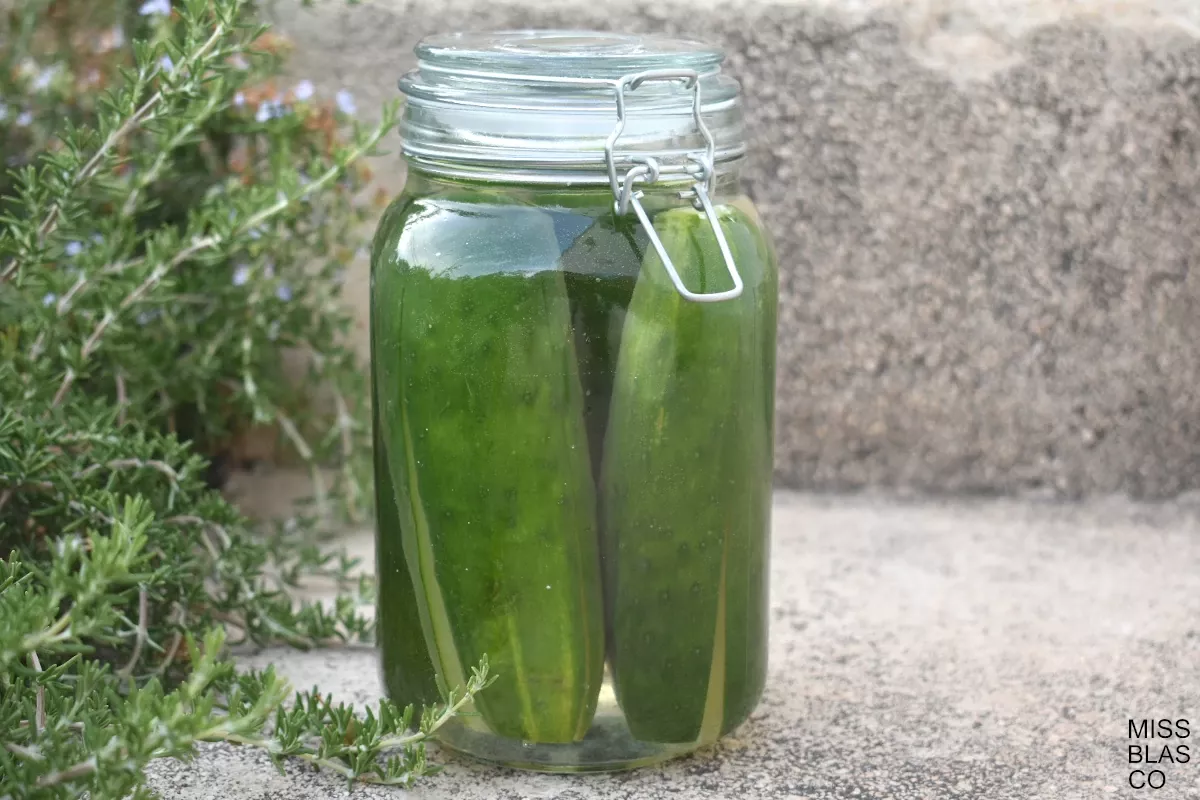
Wash the cucumbers and remove the ends. I recommend making longitudinal cuts (lengthwise), leaving the four parts joined at one end. Do not remove the skin. The skin provides the essential microorganisms needed to kickstart the fermentation.
3. The 2% Brine
For these cucumbers, I use a 2% brine. This means adding 20g of sea salt for every liter of water. Ensure the salt is completely dissolved before pouring it over the vegetables.
4. Packing the Jar
Place the cucumbers vertically in the jar. Try to fill all the space so they stay tight, this prevents them from floating. At this stage, you can add aromatics:
- Fresh dill.
- Black peppercorns or coriander seeds.
- Garlic cloves or cumin.
Note: If it’s your first time, I recommend fermenting them plain or with just a few peppercorns to learn the base flavor.
5. Keeping them Submerged
This is an anaerobic process. If the cucumbers are not packed tightly enough to stay down, you must use a weight. You can use a glass fermentation weight, a small glass filled with brine, or even a piece of carrot wedged into the mouth of the jar as a “beam” to keep everything under the liquid.
6. Storage
Cover the jar. If you use a hermetic seal, open it once a day to let the CO2 escape. Store your jar in a cool, dry, and dark place, away from direct sunlight.
Improve your digestive health by preparing vegetable ferments, a natural, ancestral way to take care of your body from the inside out.
How to Enjoy Your Fermented Cucumbers
Once the fermentation has reached your desired level of acidity and crunch, move the jar to the refrigerator. The cold will stop the process, and they will keep for many months.
- As a Garnish: Perfect for oily fish, smoked meats, or high-quality German sausages.
- In Salads: Mix them with red onion, green leaves, and a mustard-based dressing.
- Vegetarian Power Bowls: Combine with rice, sprouts, or sprouted legumes.
- The Perfect Dressing: Mustard is the best companion for fermented cucumbers. Try a mix of Dijon mustard, extra virgin olive oil, and a splash of the fermentation brine.
Why I Love This Recipe
- Low Effort: It takes very little active time to prepare.
- Affordable: Cucumbers and salt are kitchen staples.
- Probiotic Punch: It’s a direct injection of life for your microbiota.
- The Result: The flavor is surprisingly deep and refreshing.
If this idea sounds appealing to you, I encourage you to try it at home. Improving your diet and your digestive health starts with small, simple preparations like this.
Health and Happy Fermenting.
Source:
- Wild Fermentation, Sandor E. Katz.
Explore my full collection of probiotic recipes:
- How to make sauerkraut at home
- How to ferment vegetables at home
- How to make easy Kimchi
- How to ferment lemons
How to Ferment Cucumbers
Equipment
- Glass jars
Ingredients
- 4 Cucumbers Medium size, preferably organic
- 4 cups Filtered Water (1 liter)
- 1 tbsp Sea Salt
- Fresh dill (optional)
- Black peppercorns (optional)
- Garlic cloves (optional)
- Cumin (optional)
Instructions
- Wash the cucumbers and remove the ends. I recommend making longitudinal cuts (lengthwise), leaving the four parts joined at one end. Do not remove the skin. The skin provides the essential microorganisms needed to kickstart the fermentation.
- For these cucumbers, I use a 2% brine. This means adding 1 tbsp of sea salt for every 4 cups of water. Ensure the salt is completely dissolved before pouring it over the vegetables.
- Place the cucumbers vertically in the jar. Try to fill all the space so they stay tight, this prevents them from floating. At this stage, you can add aromatics: Fresh dill, black peppercorns or coriander seeds, garlic cloves or cumin. (If it's your first time, I recommend fermenting them plain or with just a few peppercorns to learn the base flavor).
- Keeping them Submerged: This is an anaerobic process. If the cucumbers are not packed tightly enough to stay down, you must use a weight. You can use a glass fermentation weight, a small glass filled with brine, or even a piece of carrot wedged into the mouth of the jar as a "beam" to keep everything under the liquid.
- Storage: Cover the jar. If you use a hermetic seal, open it once a day to let the CO2 escape. Store your jar in a cool, dry, and dark place, away from direct sunlight.
Amarilis
Gracias por esta receta. He estadouy necesitada de ella y la descubri hoy, no creo en la casualidad jjj es q realmente será muy beneficiosa a mi salud.
Llevo un buen tiempo con afecciones en la piel y con tratamiento casero para eliminar la candida xq vivo en Cuba y no tengo opcion de medicamentos farmaceuticos, uso mucho las hierbas y remedios naturales.
Estaba buscando como fortalecer mi sistema inmune y revitalizar la flora intestinal.
Gracias a un video q acabo de ver en Google de Bienestar inginito q m instruyo sobre el tema
missblasco
Hola Amarilis,
muchas gracias por tu mensaje. Me produce mucha tristeza la situación que se está viviendo en Cuba, ojalá se acabe pronto y tengáis acceso a todo lo que como ciudadanos merecéis.
En cuanto a la cándida, se trata de un desequilibrio en la microbiota, está demostrado que la mejor manera de combatir este tipo de disbiosis es con el consumo de fermentos y cambios en el estilo de vida. Los fermentos recomendados son los que se hacen con sal, como estos pepinos, pero también puedes fermentar rábanos, zanahorias, cebollas. Muy interesante el consumo de chucrut y kimchi. Por supuesto es muy importante eliminar el azúcar de la dieta y las harinas refinadas, y también es fundamental hacer ejercicio y moverse mucho.
Espero que te mejores y que todo vaya bien.
Un cordial saludo.
Francesca. 😉
Maria
Hola! Que buena receta. Tengo una pregunta: ¿Puedo cortar los pepinos en rodajas o de alguna otra manera si no tengo un bote tan alto?
Gracias!
missblasco
Hola Maria, efectivamente, puedes cortar los pepinos, pero en ese caso debes reducir el tiempo de fermentación. Si el pepino está cortado, la piel ya no actuará como protección y se fermentará más rápido. Vigila el proceso con atención.
Gracias por tu consulta, saludos!
Fgracia
Muchas gracias por la Receta. Creo que La ensaladilla tradicional de Espana con el piccadillo de vegetales como los pepinillos y las zanahorias es mas saludable con los vegetales en salmuera que en vinagre
Si se quieres conservar durante mucho tiempo como se puede sellar el bote de cristal?
missblasco
Hola, si los pepinos están en vinagre se puede hacer el procedimiento tradicional de conserva, pero si se trata de pepinos fermentados, lo ideal es consumirlos poco a poco guardándolos en la nevera, de esa forma paras el proceso de fermentación y duran mucho.
No sé si te he aclaro la duda.
Gracias por comentar! 😉
Sylvia Harroch
Thank you for all the info. I have a question: I have followed all the instructions but my cukes never obtain the sour smell that tells me they have fermented properly. Most of the time they smell musty or bad. What am I doing wrong? I heard that you should blanch the cukes before fermenting. Is that the right thing to do?
Thanks for your help,
Sylvia
missblasco
Hi Sylvia, properly fermentation depends on several factors, one of the most important is room temperature, if it’s hot fermentation time decreases, if it’s cold, fermentation time must be longer. Cucumbers are fermented in a few time, so check that requeriment because it’s critical.
To blanch the cucumbers is not necessary, to wash it well should be enough.
Clean glass jars, dark storage and the right period of time is all you need to ensure a good result.
Many thanks for your question.
Dante Linares
Hola desde Perú.
Una pregunta, si el pepino es demasiado largo para el envase, puedo ponerlo en mitades?, de ser así, las partes con cortes hacia donde deben apuntar,. hacia el fondo o hacia la boca del envase?
missblasco
Hola Dante, en primer lugar me disculpo por la tardanza en responder.
En cuanto a los pepinos puedo decirte que sí se pueden cortar y que es indiferente ponerlos en una dirección u otra, aunque yo los pondría mirando hacia abajo siempre.
Saludos.