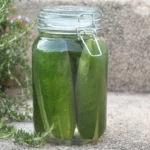
How to Ferment Cucumbers
Learn how to ferment cucumbers at home and discover the benefits of probiotic pickles to improve your digestive health and microbiota.
Servings 4 portions
Calories 144kcal
Equipment
- Glass jars
Ingredients
- 4 Cucumbers Medium size, preferably organic
- 4 cups Filtered Water (1 liter)
- 1 tbsp Sea Salt
- Fresh dill (optional)
- Black peppercorns (optional)
- Garlic cloves (optional)
- Cumin (optional)
Instructions
- Wash the cucumbers and remove the ends. I recommend making longitudinal cuts (lengthwise), leaving the four parts joined at one end. Do not remove the skin. The skin provides the essential microorganisms needed to kickstart the fermentation.
- For these cucumbers, I use a 2% brine. This means adding 1 tbsp of sea salt for every 4 cups of water. Ensure the salt is completely dissolved before pouring it over the vegetables.
- Place the cucumbers vertically in the jar. Try to fill all the space so they stay tight, this prevents them from floating. At this stage, you can add aromatics: Fresh dill, black peppercorns or coriander seeds, garlic cloves or cumin. (If it's your first time, I recommend fermenting them plain or with just a few peppercorns to learn the base flavor).
- Keeping them Submerged: This is an anaerobic process. If the cucumbers are not packed tightly enough to stay down, you must use a weight. You can use a glass fermentation weight, a small glass filled with brine, or even a piece of carrot wedged into the mouth of the jar as a "beam" to keep everything under the liquid.
- Storage: Cover the jar. If you use a hermetic seal, open it once a day to let the CO2 escape. Store your jar in a cool, dry, and dark place, away from direct sunlight.
Nutrition
Calories: 144kcal | Carbohydrates: 26g | Protein: 7g | Fat: 2g | Saturated Fat: 0.2g | Polyunsaturated Fat: 0.04g | Monounsaturated Fat: 0.02g | Sodium: 7048mg | Potassium: 1633mg | Fiber: 8g | Sugar: 17g | Vitamin A: 864IU | Vitamin C: 38mg | Calcium: 201mg | Iron: 3mg