5 Steps to End Constipation
5 Steps to End Constipation: The Definitive Guide to Regaining Your Natural Rhythm
Constipation is a silent and annoying companion in the lives of many people. It isn’t just a feeling of heaviness or bloating; it is a sign that something in our complex internal system is not functioning in harmony.
Often, this problem is a consequence of a lack of movement and an inadequate diet, but factors such as the stress of daily life and disordered schedules do not help either.
As a nutritionist, I see daily how people often seek solutions in quick laxatives that only act as a “band-aid” for the problem. Real success in restoring intestinal transit lies in a comprehensive approach that “sets your body’s clock,” heals your gut, and restores your regularity.
Here are the keys to saying goodbye to constipation (or at least, ensuring it is no longer the norm):
1. Heal your gut and its mucosa
To start, it is important to assess the state of your intestine. Simply consuming fiber is not enough; this will not solve the problem. On the contrary, if the intestine is inflamed and blocked, consuming more fiber can cause the opposite effect of what is desired.
If your intestine is inflamed, your mucosa is irritated. In that case, fiber will not act as a “broom”, it won’t push the contents of the intestine along. Instead, it will get stuck, ferment, and produce gas and bloating, inevitably forming a blockage. Therefore, the first step to preventing constipation is to reduce inflammation in the gut.
How?
- Drink water with lemon juice and a pinch of sea salt first thing in the morning, on an empty stomach, at room temperature or warm. By adding electrolytes, you achieve deeper hydration that affects the fecal bolus.
- Take Magnesium Citrate (or Bisglycinate) before going to sleep. Magnesium draws water into the colon via osmosis and relaxes the intestinal muscles. It is not an irritating laxative; it is a mechanical facilitator.
- Take a tablespoon of extra virgin olive oil or coconut oil (MCTs) on an empty stomach. Fat acts as a lubricant and helps stimulate the gastrocolic reflex.
Constipation is the result of a mismatch between our lifestyle and our biological clock.
If, in addition, your intestinal walls are damaged, there may be permeability. Repairing this is fundamental to healing.
What can be done?
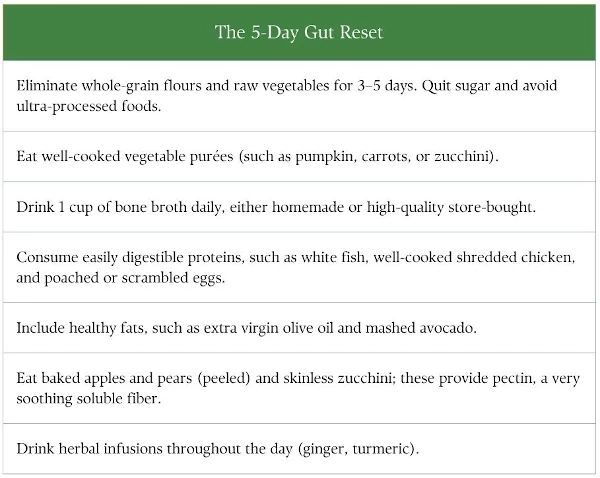
- Drink bone broth: This recipe is rich in glycine and collagen, providing the amino acids necessary to rebuild the mucus barrier that protects the lining of the intestinal wall.
- Ginger or turmeric infusions: These have an anti-inflammatory effect.
- L-glutamine: This is an amino acid that helps repair enterocytes (intestinal cells) and lower inflammation. You can start with 5g of powder dissolved in water on an empty stomach.
- Include digestive bitters (artichoke, black radish, or simply lemon water) to help bile flow. Bile is the body’s most powerful natural laxative.
The 5-Day Gut Reset: Soothing your digestive system
2. Introduce fiber and probiotics into your diet
After a week of following the previous steps to reduce inflammation and empty your gut, gradually reintroduce foods that provide dietary fiber.
The key lies in fresh foods, fruits and vegetables that provide quality fiber, and in avoiding ultra-processed products. Refined products loaded with sugars slow down digestion and damage your intestinal flora. We must place special emphasis on those with prebiotic fiber.
- Asparagus, artichokes, cabbage, garlic, and onion are food for your beneficial bacteria.
- Cooled potatoes (resistant starch), which act as an excellent prebiotic to improve your microbiota.
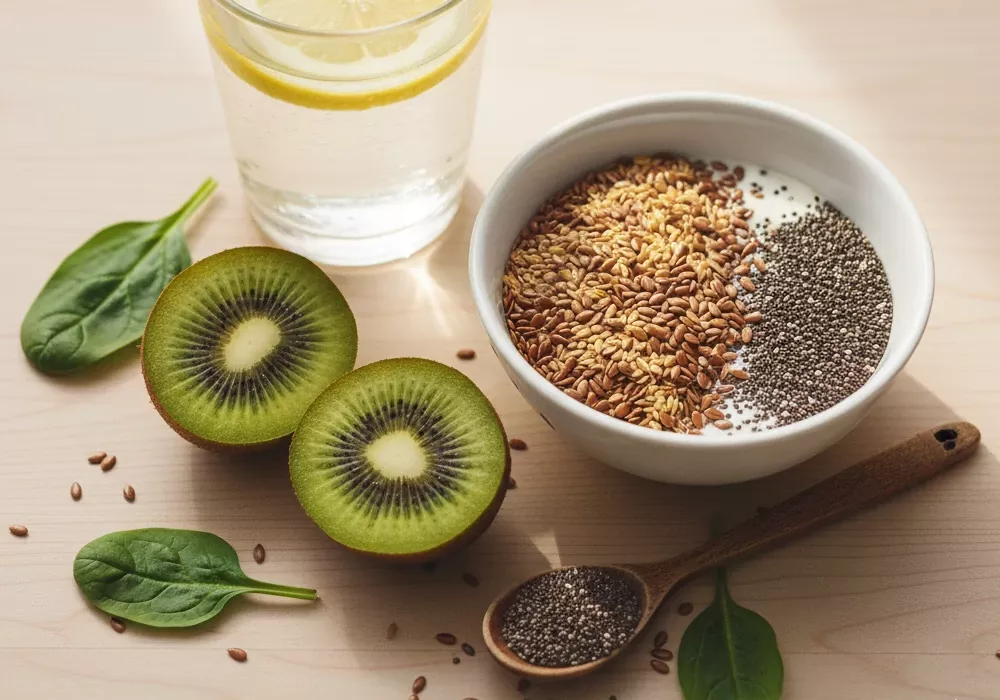
- Seeds: ground flax, and chia when hydrated, create a mucilage (a type of gel) that has considerable “dragging” power in the intestine, helping to clean it gently.
- Psyllium Husk.
Consume probiotic foods progressively:
- Sauerkraut (fermented cabbage): You can make it at home or buy it, but keep in mind it must not be pasteurized.
- Kefir: Buy goat kefir to start, as it is milder.
- Yogurt.
- Other fermented vegetables.
You can also consume a probiotic-based supplement. The two most recommended for constipation are Saccharomyces boulardii (a beneficial yeast that cleanses rather than colonizes) or Lactobacillus rhamnosus GG.
If the bacteria in your gut are in balance, transit will be a natural consequence of that internal health.
3. Movement
- Abdominal massage in a clockwise direction and diaphragmatic breathing are vital for reducing sympathetic tone (stress) that paralyzes the intestine.
- Walk more: It is not necessary to run a marathon, but you must establish a commitment to your body, at least 1 hour a day at a brisk pace.
- Strength training and core strengthening: Strong abdominal muscles assist in the evacuation process, providing the necessary pressure naturally and without excessive effort.
4. Hydration: The vehicle for cleansing
As noted in the first section, you must drink enough water, our body needs it so that fiber can perform its function.
Try to drink between 1.5 and 2 liters (6-8 cups) of water a day and start with a glass of water on an empty stomach (preferably warm).
Drink infusions throughout the day to maintain constant hydration and provide antioxidant and anti-inflammatory compounds.
Your gut needs movement, hydration, and, above all, a marked routine to function like a Swiss watch.
5. Stress management and circadian rhythm
There is a direct connection between your mind and your digestive system.
- Reduce your stress: Disciplines such as yoga, pilates, or simple daily stretching are powerful tools for releasing accumulated tension.
- Rest: A lack of rest raises cortisol, a hormone that can paralyze your intestinal rhythm.
- Establish routines: Avoid blue light from screens, especially at night, and get sunlight during the day.
- Live by day and sleep by night; eat by day and fast by night.
- Set your meal times and try to make the last one as early as possible.
- Bathroom routine: Try to go to the bathroom every day at the same time.
A balanced microbiota is the basis of optimal digestive health and a strong immune system.

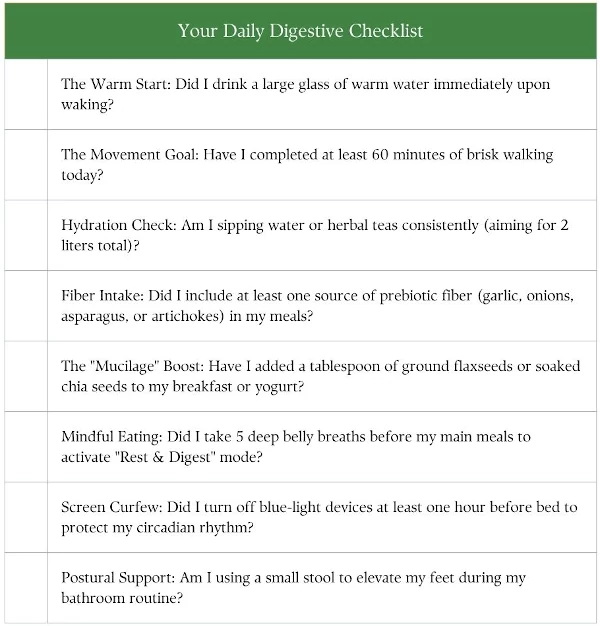
Your Daily Digestive Checklist
The key to “setting the clock” for your system is consistency.
Conclusions
These 5 pillars are the key to real, lasting improvement. Do not look for miracle overnight solutions; instead, help your body by re-syncing its biological clock. When you adjust your schedules, your nutrition, and your activity levels, everything else will follow. Your digestive health is a reflection of your daily balance.
Sources
- Araújo, M. M., & Botelho, P. B. (2022). Probiotics, prebiotics, and synbiotics in chronic constipation: Outstanding aspects to be considered for the current evidence. Frontiers in Nutrition, 9, 935830. https://doi.org/10.3389/fnut.2022.935830
- Erhardt, R., Harnett, J. E., Steels, E., & Steadman, K. J. (2022). Functional constipation and the effect of prebiotics on the gut microbiota: a review. British Journal of Nutrition, 130(6), 1015–1023. https://doi.org/10.1017/s0007114522003853
- Lai, H., Li, Y., He, Y., Chen, F., Mi, B., Li, J., Xie, J., Ma, G., Yang, J., Xu, K., Liao, X., Yin, Y., Liang, J., Kong, L., Wang, X., Li, Z., Shen, Y., Dang, S., Zhang, L., . . . Liu, X. (2023). Effects of dietary fibers or probiotics on functional constipation symptoms and roles of gut microbiota: a double-blinded randomized placebo trial. Gut Microbes, 15(1), 2197837. https://doi.org/10.1080/19490976.2023.2197837
- Mitelmão, F. C. R., Häckel, K., De Cássia Bergamaschi, C., Gerenutti, M., Silva, M. T., Balcão, V. M., & Vila, M. M. D. C. (2022). The effect of probiotics on functional constipation in adults: A randomized, double-blind controlled trial. Medicine, 101(43), e31185. https://doi.org/10.1097/md.0000000000031185
Discover more
- Best Foods Over 40
- Anti-inflammatory Diet
- Easy Bone Broth Recipe
- How to ferment vegetables at home
- How to ferment cabbage at home (Sauerkraut)